Fishing Boats Hit When Portugal's Sole Quota Ran Out Early Can Claim a Share of 360,000 Euros by 31 October
A new order compensates small mainland boats that rely on sole for part of what they lost after the catch limit was used up. The payout is based on each boat's 2024 and 2025 sales, with a 500 euro minimum.
Small fishing boats that lost income when Portugal's quota for common sole ran out this year can now claim compensation. Portaria n.º 446/2026/1 (Ministerial Order 446/2026/1), published in the Diário da República (official gazette) on Wednesday, sets aside 360,000 euros for owners of mainland boats that depend on the fish. Claims close on 31 October.
The order covers the loss boats have already borne between June and September 2026, after fishing aimed at common sole (linguado-legítimo, Solea solea) was closed because the catch limit had been used up. Sole fetches a high price, and the order says the closure hit hardest the boats of the small multi-gear fleet (pesca polivalente) that rely on it most. It measures each boat's dependence through its sales from trammel nets (tresmalho).
Why the quota ran short
Portugal and Spain share a single EU catch limit for sole in a stretch of the Atlantic running from the Bay of Biscay down Iberia's west coast and out to the Azores and Madeira. A Council regulation of 26 January, Regulation (EU) 2026/249, set it at 492 tonnes for 2026 and 2027, of which common sole may not exceed 190 tonnes, 19 tonnes less than the 209 tonnes allowed in 2025.
Then the rules changed mid-year. Regulation (EU) 2026/786 of 30 March brought sand sole (linguado-da-areia, Pegusa lascaris) into the same management unit, backdated to 1 January. Its catches began to count against the same quota, which was not raised. The ministry says this made the fishing opportunities run out faster.
Who can claim
The aid is for owners of multi-gear boats registered in the mainland fleet that held a valid fishing licence. A boat qualifies if sole made up more than 10 percent of the value of its trammel-net sales in 2024 and 2025 combined. Boats with sole sales but no trammel-net sales qualify if sole was more than 10 percent of all their sales over the two years.
The amount per boat is set by a formula: the average annual value of its sole sales in 2024 and 2025, multiplied by sole's share of the relevant sales, multiplied by 30 percent. Only sales in official records count, as validated by the Direção-Geral de Recursos Naturais, Segurança e Serviços Marítimos (Directorate-General for Natural Resources, Maritime Safety and Services, DGRM). The minimum payment is 500 euros per boat.
As an illustration of our own: a boat that sold 20,000 euros of sole in 2024 and 16,000 euros in 2025, out of 120,000 euros of trammel-net sales over the two years, would have a sole share of 30 percent. It would receive 18,000 euros times 30 percent times 30 percent, or 1,620 euros.
How to apply
Owners apply to the DGRM through its online portal, the Balcão Eletrónico do Mar (BMar), by 31 October 2026. The DGRM works out the sales figures itself from official data. Applicants' tax and social security affairs must be in order, and payment is made in a single transfer.
The aid is granted under the EU's de minimis rules for fishing and aquaculture (Regulation (EU) No 717/2014), so a payment is cut if it would push a business over its de minimis ceiling. The order was signed on 25 September by the Secretary of State for Fisheries and the Sea, Salvador Malheiro, and takes effect on Thursday.
The order does not say how many boats will qualify. For background, see how the country allocates its fishing opportunities.
Source: Portaria n.º 446/2026/1, Diário da República, 1st series, no. 190, 30 September 2026 (in Portuguese). The worked example is our own calculation from the order's formula.
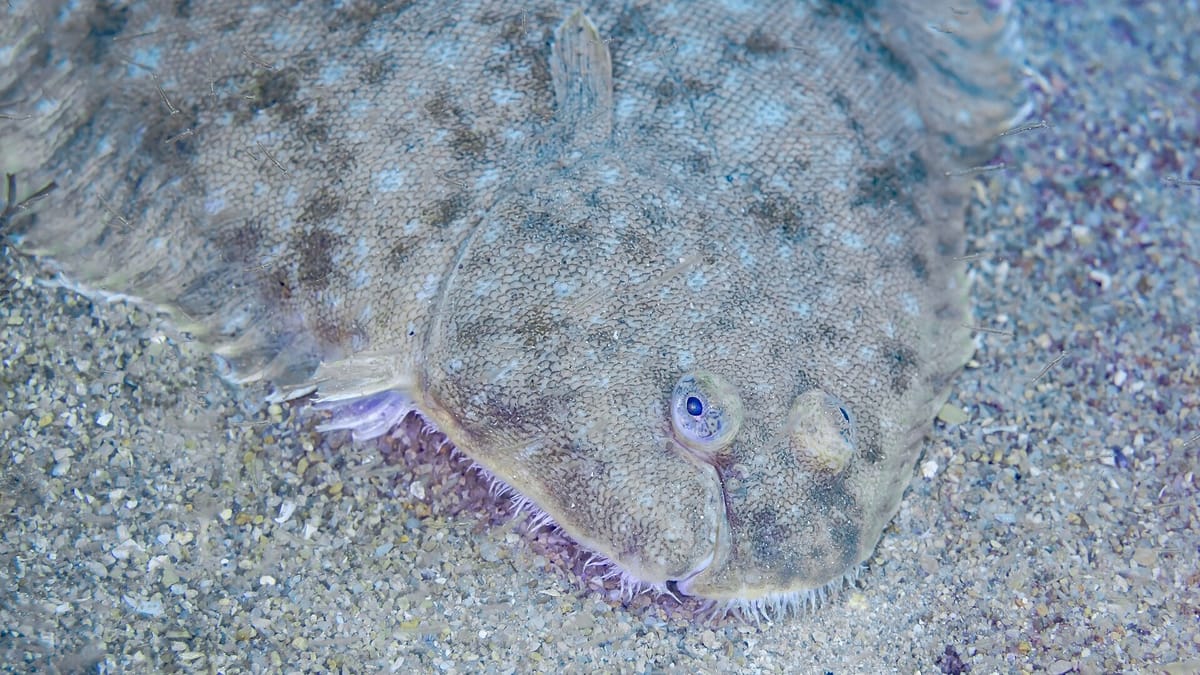
Feature image: a common sole in the Arrábida Natural Park. Photo by Diego Delso (CC BY-SA 4.0), via Wikimedia Commons.