November Rain Refills Portugal's Reservoirs to 78 Percent After the Driest October in 40 Years, and Every District Is Above Its Monthly Normal
By 24 November mainland rainfall was at about 180 percent of the monthly normal, making this one of the four wettest Novembers since 2000, IPMA says. APA puts reservoirs at 78 percent, every basin above its November average. A drought update is still to come.
A month that began with much of mainland Portugal in severe drought is now among the wettest of the century. By 24 November, rainfall averaged across the mainland had passed 200 millimetres, about 180 percent of the November normal for 1991 to 2020, the Instituto Português do Mar e da Atmosfera (IPMA, the national weather institute) said in a preliminary note this week. That puts November 2026 among the four wettest since 2000, alongside 2006, 2014 and 2025. The month still had six days to run.
The turnaround is sharp. October had only 11 percent of its normal rainfall, the driest October in 40 years, and at the end of that month IPMA's drought index put about half of the mainland in severe drought and a quarter in extreme drought.
Where the rain fell
Every district has had more rain than its monthly normal so far, IPMA says, and Castelo Branco stands out at 250 to 300 percent. At several stations, more than a quarter of all the rain recorded since January fell in the first 22 days of November: 34.9 percent in Castelo Branco, 31.1 percent in Avis, 30.0 percent in Mora, 29.6 percent in Rio Maior and 29.5 percent in Alvega.
Most of it came in two bursts. Depressions Bruna and Charles, between 7 and 12 November, set four new daily rainfall extremes and four new wind-gust extremes for the month, according to IPMA's review of the two storms, including 119.2 millimetres in 24 hours at the institute's Lisbon headquarters and a gust of 123.5 km/h at Fóia, in the Algarve.
Then a cold front carrying moisture from the tropical Atlantic crossed the country from 20 to 22 November. The heaviest totals were in the North and Centre, especially the Ribatejo, the western Oeste coast and the inland Centre. Tomar had 109.5 millimetres in 24 hours, 108.1 of them in just 12 hours, followed by Rio Maior (97.6) and Covilhã (92.6). At five stations, more than 60 millimetres fell in six hours, the threshold for a red rain warning. No all-time daily record was broken. That weekend's rain brought more than a thousand civil protection call-outs.
Reservoirs back above the November average
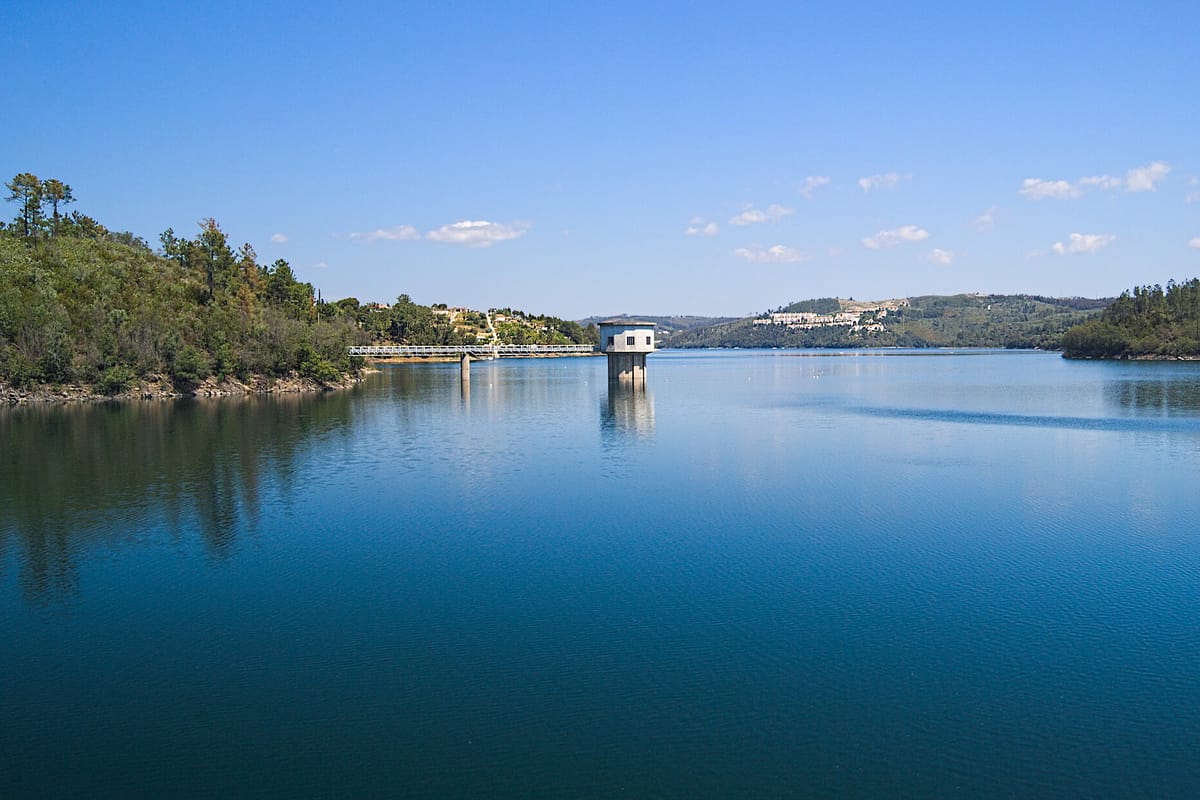
The rain is already showing in storage. The Agência Portuguesa do Ambiente (APA, the Portuguese Environment Agency) weekly reservoir bulletin for 23 November puts the water held in the monitored reservoirs at 10,223 cubic hectometres, about 78 percent of their combined capacity of 13,165. That is 632 cubic hectometres more than a week earlier.
Storage rose in 13 river basins and fell in one. Nearly half of the monitored reservoirs (47 percent) are more than 80 percent full, and only 5 percent are below 40 percent. Every basin is now above its average storage for November, measured against records going back to 1990/91.
Is the drought over?
Not officially, yet. IPMA's drought monitoring page still shows the end-of-October picture, and the institute has not yet published an index for November. Its notes on this month's rain are marked as a preliminary analysis. The next drought update will be the one to watch, particularly for the interior South, where the October figures were worst.
For households, the practical news is mostly good: the main public-supply reservoirs go into winter in a far better position than in early autumn. The 2025 to 2026 hydrological year, which ended on 30 September, was the warmest since 1931 and the second wettest since 2000, but it ended in drought. The new one has started the other way round.